Warnings & validation
After the transformation, an independent pass re-scans the anonymized output. It never edits anything — it only reports. That report is the status line at the top of the result.
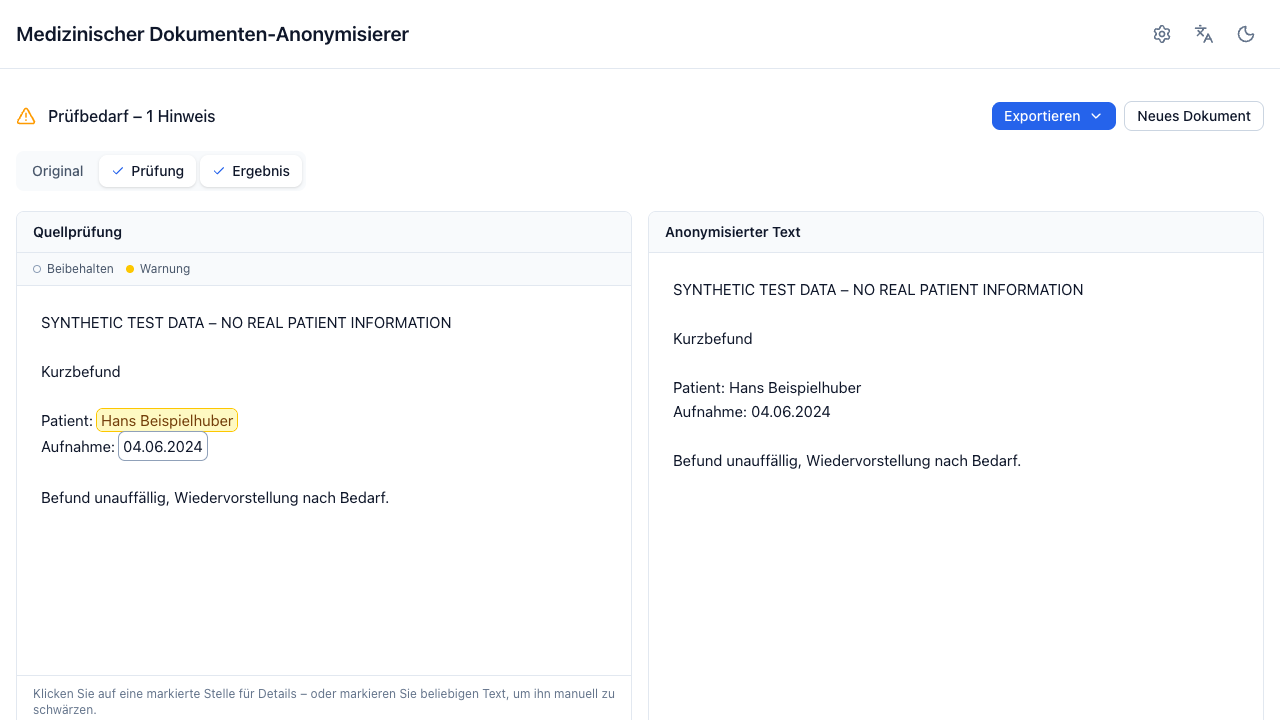
The three statuses
| Status | Shown as | Meaning | What to do |
|---|---|---|---|
PASS |
Geprüft – keine Auffälligkeiten | No warning above informational level. | Still read the output. A passed check means nothing suspicious was found, not that nothing was missed. |
REVIEW_REQUIRED |
Prüfbedarf – N Hinweise | At least one warning. | Work through the list; each locatable warning links into the source. |
FAIL |
Prüfung fehlgeschlagen | Something critical: text that should have been redacted still appears in the output. | Do not use this output. Report it — a FAIL usually indicates a bug or a pathological document. |
What the validator checks
- Residual identifiers. Every non-preserved entity's original text must
not appear anywhere in the output. A hit here is
HIGHseverity and fails the document. - Rule re-detection. The rule detectors run again on the output. Anything they still find — an e-mail, a phone number, a labelled ID — becomes a warning.
- Labelled fields.
Patient:,Name:,Anschrift:,Adresse:,Wohnhaft:followed by something that is not a placeholder. This is the check that most often catches a name the detectors missed entirely. - The LLM audit (when enabled). The model reads the anonymized output with an auditing prompt and reports what personal data it still sees, plus an overall re-identification risk. Placeholders, preserved dates and bare years are excluded so it does not report its own output back.
- Detector problems. If a detector reported a mention that could not be located in the source, or produced a span that failed verification, that becomes a warning too — the document may not have been checked completely.
Reading the list

Hinweise & Warnungen is expanded automatically whenever the status is not
PASS. Warnings are colour-coded by severity, and those that point at a
position offer Im Text anzeigen, which scrolls the source panel to the spot
and highlights it in yellow.
Blue items at the bottom are general processing notes rather than validation findings — for example that page mapping is unavailable, that OCR was used, or that the LLM re-check was not repeated after a correction.
In expert mode each warning also shows its
severity and its category slug (residual_identifier, revalidation_hit,
labelled_field, llm_recheck, detector), which is what you quote in a bug
report.
Common warnings
Warnings appear in the interface language; the German wording is quoted here, with the stable code the backend sends alongside it (useful in a bug report, and the same in every language).
Warning (code) |
Usual cause | Response |
|---|---|---|
Auf ein beschriftetes Feld folgt offenbar nicht geschwärzter Inhalt (labelled_field) |
A name the detectors missed, or a field the policy deliberately preserves. | Look at the spot. Redact it manually if it is an identifier. |
Eine Regel erkennt im Ergebnis weiterhin eine mögliche Stelle vom Typ … (revalidation_hit) |
An identifier in an unusual format, or one you preserved on purpose. | Check whether the preservation was intended. |
Geschwärzter Inhalt vom Typ … scheint im Ergebnis noch vorhanden zu sein (residual_identifier) |
A genuine bug or a pathological overlap. | Do not use the output; report it with the document type (never the document). |
Die KI-Nachprüfung wurde für dieses angepasste Ergebnis nicht wiederholt (llm_recheck_skipped) |
Informational — you corrected an entity after the audit ran. | Re-run from scratch if you want a fresh audit. |
Der Text stammt aus einer Texterkennung (OCR); Erkennungsfehler sind möglich (ocr_recognition_errors) |
Informational, on every scanned document. | Bad OCR hides identifiers from detection. Skim the source panel for garbled passages. |
The limits of this check
The validator is a second opinion on the output, not an independent detector on the input. It cannot find an identifier that no detector recognized and that sits in no labelled field and matches no rule — for example a bare surname in running prose.
That is why PASS means "nothing suspicious was found", human review is
required, and the honest way to know how well the pipeline performs on your
documents is to measure it: Evaluation.